
The Hidden Cost of Ignoring Your Financial Plan

When life is busy with work, family, school runs, holidays and unexpected expenses, financial planning often ends up somewhere near the bottom of the to-do list, especially if things feel reasonably stable. If there are no immediate problems, it is easy to just leave things as they are and think to yourself, I’ll sort my financial plan out another time.
But doing nothing with your finances is still a decision, and over time that decision can have a cost. It is not always an obvious one, as there is no dramatic change, but rather a slow drift away from the opportunities that come from being intentional with your money.
Why people avoid financial planning
In most cases it isn’t because of laziness that prevents people from engaging with their finances. Sometimes it could simply be procrastination. Money decisions can feel complex, and when something is complicated, our instinct is often to delay it. It might be because you feel you really need to set aside a large chunk of time to get to grips with your financial plan, and at the moment you feel you simply do not have time to prioritise this.
Other times there may be a quiet fear behind the avoidance. A worry that if you look too closely at the numbers then it might highlight something that feels uncomfortable. You may already know you are not saving enough, but by not focusing on it you feel that ignorance is bliss. Sometimes people genuinely believe that their finances will naturally sort themselves out in the future. Maybe you believe your current pension contributions will grow enough, current investments will take care of themselves, and there will always be time to adjust later. But time is one of the financial assets we can’t replace.
You are not alone if you think this. Most clients who are approaching retirement are apprehensive as to what this looks like. The state pension tends to be the line in the sand for most people as to when they feel able to stop working. But what if careful planning could give you more control over that timeline and potentially bring your retirement forward?
The hidden cost of inaction
When people think about financial mistakes, it is often poor investments or bad decisions that come to mind. However, in reality one of the most expensive financial decisions can simply be doing nothing at all.
Time
Time is one of the most powerful forces in financial planning. Money invested earlier naturally has more time to grow. This can be seen as a barrier in itself, as it is easier to tell yourself, I don’t have any more to invest at the moment so I will do it later when I have. However, even small consistent amounts over many years can really build up over time. It’s worth reading our blog on The power of compounding and why starting early matters.
When you delay planning, the window for those small steady improvements gets smaller, and often the only way to catch up is by saving significantly more or adjusting expectations. If left too late, sometimes people start to take greater risks outside of their comfort zone and may begin looking at investments that might provide a greater return. This can lead to making rash, maybe risky decisions that turn into poor financial decisions, putting you in a worse situation.
Missed opportunies
The UK financial system offers a range of tax-efficient opportunities designed to help people grow and protect their wealth, but they only work if they are used. Unused ISA allowances, unfunded pensions, or savings sitting in accounts earning little to no interest can erode your financial progress over time.For more information on tax-efficient savings, you can read the complete guide on tax-efficient saving.
Financial strain later on
Leaving your finances unattended for too long can force decisions that could have been gradual to feel suddenly quite urgent. Questions about retirement, income, and family security can all appear at once, creating added pressure and potential unnecessary stress. At this point, money can start to feel overwhelming.
What doing nothing looks like in real life
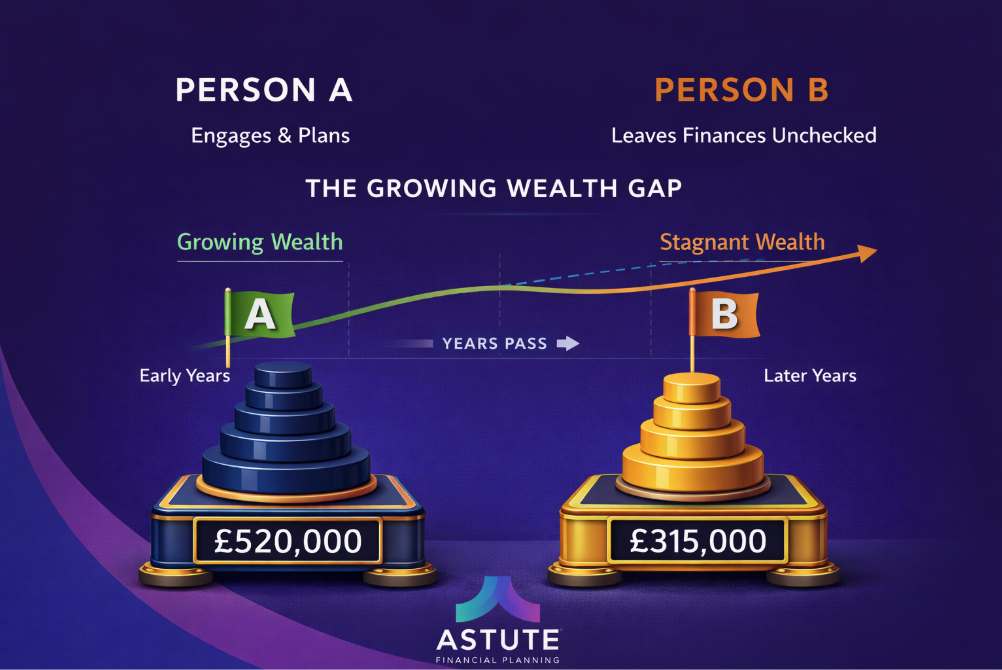
Imagine two scenarios. Person A and Person B are in a similar financial position. They broadly have the same value of assets and a similar income.
Person A takes some time to set out their financial plan, regularly checking in and evaluating their current progress. They gradually increase their pension contributions, they also make use of their tax allowances and check that their wealth is steadily growing over time.
Person B assumes things are fine and leaves everything untouched, not really ever evaluating what they have now and what they will likely have in the future.
For the first few years, there is likely little visible difference between them in terms of wealth generation, but over time the wealth gap will grow. The gap doesn’t appear overnight. It grows slowly, almost invisibly, until one day the difference becomes obvious. Not because one person took huge risks or made brilliant investment calls. But simply because one chose to engage with their finances, while the other didn’t.
Financial planning isn’t about perfection
There is a misconception about financial planning that you need to have everything organised before you start. In reality, very few people do. Of course it is important to know your incomings and outgoings, but overcomplicating things can create barriers to focusing on it, as highlighted above.
Plans do evolve, and they should as circumstances change. Life is never straightforward, and financial planning isn’t about predicting every outcome or making flawless decisions. It is about creating direction and ensuring that you are going in the right direction so that you can support the lifestyle you want in the future. Understanding where you are today, where you’d like to be in the future, and making thoughtful adjustments along the way. Sometimes the biggest benefit isn’t even the numbers themselves. It’s the sense of clarity that comes from knowing you’ve taken control of the situation.
Small steps that make a big difference
The good news is that by starting today, instead of putting it off, you can avoid the cost of leaving things too late. Often, it begins with a few simple steps:
- Understanding where your money currently sits
- Reviewing pensions and long-term savings
- Making sure tax allowances are being used efficiently
- Setting realistic goals for the future
- Creating a plan that can adapt as life changes
None of this needs to happen overnight. What matters is starting.
A final note
Most financial progress doesn’t come from one perfect decision. It comes from small, consistent actions over time. Doing nothing or delaying might feel like the safest or easiest option in the moment, but in the long run, inaction can quietly shape your financial future, making it harder to influence later on. The difference is that one approach gives you options, and the other slowly removes them. So the real question might not be whether you’ve made the perfect financial plan. It might simply be: Have you started one at all?
At Astute Financial Planning, I create financial plans tailored to your life, your goals, and your future. If you would like expert guidance designed around you, please get in touch. Learn more about my approach to financial planning here
Disclaimers:
Approver Quilter Financial Services Limited May 2026.
The value of investments and the income they produce can fall as well as rise. You may get back less than you invested.
Tax Planning is not regulated by the Financial Conduct Authority.
Tax treatment varies according to individual circumstances and is subject to change.

Ready to get started?
Get in touch today
If you would like to arrange a meeting with Sarah, please complete the attached form you can schedule in a 15 minute initial telephone call.